Am I the only one fascinated by pulley lights? Functionally, I love the idea of having an adjustable height light -- position it high for dinner, then pull it closer when you are working at the same table. Aesthetically, I like the exposed pulleys and cords.
There are a number of different models and styles available, many for about $200.
Architects and Heroes, a hometown favorite, makes a wide variety of these clever lights.
There are a lot more around, just google "Pendant Pulley" to find even more examples of these neat lights.
Thursday, February 7, 2008


Wednesday, February 6, 2008
Metal Bathroom
Just ran across this bathroom remodel. I know, I know, it's corrugated steel -- but just imagine it in copper or brass? Note how the designer (laughalita) used pipes for the towel racks, and very steampunk style lighting fixtures. I love the sink.

Friday, February 1, 2008
Need a pen?

The 1010 -- named after the "magic moment when the hands are in perfect balance" -- is a limited edition pen inspired by the wathmaker's art produced by Caran d'Ache.
(The links are to a very loud and flash heavy site.)
Another great find by Gary.
Wednesday, January 30, 2008
From Planes to Furniture
Furniture designer Giancarlo de Astis designs wonderful furniture out of old airplane parts.
 Il Cardine, a lamp from mahogony and an aircraft door hinge.
 Il Sole, made of jet engine turbine blades and burl walnut. (The knights of the round table would have loved it!)
According to his website, Giancarlo earns his artistic license in the American West, where creative man-hours are embedded in the shapes of thousands of airplanes glimmering under intense heat awaiting their irrevocable meltdown in the desert bone yards of Arizona.
Similar to old prospectors spotting potential sites, Giancarlo delicately selects each airplane part that beams the brilliance of its engineered design.
A trip to the junkyard has never sounded so romantic!
Thanks to reader Gary for sending me these.
Tuesday, January 29, 2008
Build your own hidden door
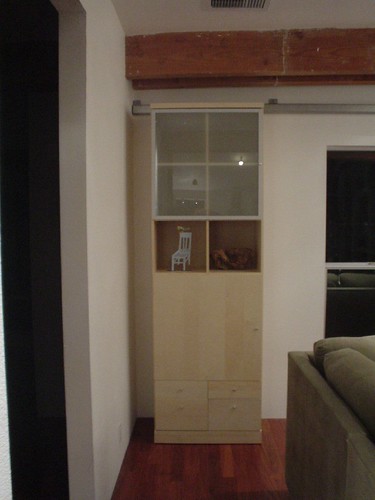
Remember this library with a secret powder room behind a bookshelf? I just ran across instructions for making something similar from off the shelf parts at Ikeahacker...
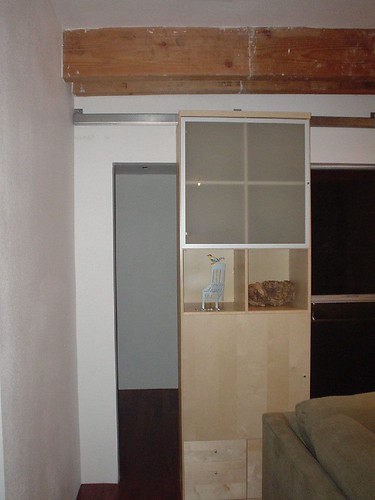
You'll have to play with the aesthetics a bit to make it steampunk styled, but the idea was too good not to share.
Monday, January 28, 2008
Mod My Fridge!

So if you were around last summer for the refrigerator posts, you may remember that I was leaning towards modding a panel front refrigerator as the most cost effective way to get a stylish fridge. After some regular Craigslist watching, $400, and the manual labor to haul it home 30 miles, I'm now the proud owner of a 5 year old, cabinet front, counter depth, GE fridge similar to this one.
So what's a steampunk homemaker to do with such a thing? It probably isn't the obvious first thing, but I've started by buying gauges on Ebay.
 I liked the irony of having a heater gauge on a refrigerator.
 This one is actually a working fridge thermometer -- if I get the probe sensor inside, I'll actually get the internal temperature on the outside.
 This one is just a pressure gauge, easy to find on eBay.
 Gauges for Milliamperes and Microamperes
Beyond the obvious "buy cool stuff" part of it, I think the actual first step is going to be finding/fitting/cutting some brass sheets to replace the cabinet fronts with.
I'm not the most artistic person, so I'm a bit worried about the whole "design something that looks good" aspect of this project. I'm taking inspiration from this Kohler ad, the Steampunk Treehouse, and Roger Wood's Klockwerks.
I'm soliciting ideas -- what else should I do with it? Do I go overboard and cover the entire front or should I take a more restrained approach? Any ideas for how to cover the black plastic of the water dispensor and the black handles that run the length of the doors? At this stage of the project, I'm open to any suggestion, no matter how crazy. Bring it on.
Saturday, January 26, 2008
On Heaters and Radiators
Here's some heat related goodness to warm you up this winter.
Reader Joe Kesselman sent me a link to a Turkish company, Carisa, who is making hot water radiators in some very unique shapes. Unfortunately, all are chromed stainless steel and not warm steampunk metals, but they do have some clever designs.
The pipe organ style is the cleverest:
In only slightly related news, reader Paul Hulbert sent me this device from the South Western Electricity Historical Society in Bristol, UK.

My first guess was that it was a 1960s mod of a Victorian device, but it turns out I was wrong -- the extremely modern looking innards are just as Victorian as it's outtards.
This type of heater was available around the turn of the (19th!) century. This Apollo "Dowsing Sausage" Fire dates from approximately 1910. My friend and former colleague John Heath of the SWEHS explains that:
The electric filament lamp was considered inefficient because far more energy was converted into heat than produced light.
H. J. Dowsing, in 1896, designed a "heating lamp" with a frosted glass envelope. It had a 250 watt carbon filament which gave off no light except a warm red glow.
These were the first practical electric radiant heaters.
The Cannon bulb fire in 1904 had four of the "Dowsing Sausages" set against a polished reflector and controlled by brass switches.
The Apollo fire in the museum is similar.
Anyone visited the SWEHS in Bristol? It sounds like a lovely place!
Thank you Paul and Joe (and John!) for sharing these with us.
Reader Joe Kesselman sent me a link to a Turkish company, Carisa, who is making hot water radiators in some very unique shapes. Unfortunately, all are chromed stainless steel and not warm steampunk metals, but they do have some clever designs.
The pipe organ style is the cleverest:

In only slightly related news, reader Paul Hulbert sent me this device from the South Western Electricity Historical Society in Bristol, UK.

My first guess was that it was a 1960s mod of a Victorian device, but it turns out I was wrong -- the extremely modern looking innards are just as Victorian as it's outtards.
This type of heater was available around the turn of the (19th!) century. This Apollo "Dowsing Sausage" Fire dates from approximately 1910. My friend and former colleague John Heath of the SWEHS explains that:
The electric filament lamp was considered inefficient because far more energy was converted into heat than produced light.
H. J. Dowsing, in 1896, designed a "heating lamp" with a frosted glass envelope. It had a 250 watt carbon filament which gave off no light except a warm red glow.
These were the first practical electric radiant heaters.
The Cannon bulb fire in 1904 had four of the "Dowsing Sausages" set against a polished reflector and controlled by brass switches.
The Apollo fire in the museum is similar.
Anyone visited the SWEHS in Bristol? It sounds like a lovely place!
Thank you Paul and Joe (and John!) for sharing these with us.
Subscribe to:
Posts (Atom)
LinkWithin
