Friday, January 25, 2008

Are you an Alchemist?

I was struck by Dylan Kehde Roelofs saying he was an alchemist -- a word that we don't use much anymore, even if we have the chops to back it up. It made me start thinking that perhaps I'm an alchemist, too!

Let's look at some examples that happen in my house:
  • turning milk into cheese
  • turning water and grain into beer
  • apple juice into hard cider

{I wonder -- does turning electricity into light count? }

It may not be as romantic as turning lead into gold, but I definitely think these sorts of projects qualify as alchemy.

Why am I even thinking about this? Steampunk is the intersection of the Maker movement with science fiction aesthetic and a revival of interest in the Victorian. Would it have gotten off the ground, and be gaining speed as quickly as it is, without physical goods made by hand by people like Jake von Slatt or Datamancer? Those first steampunk pieces thrilled us -- made us say "I want to be part of this! I want this to be part of my life." -- but without them we may not even of known that this thing called steampunk exists.

The struggle for me is in finding some level of "authenticity" within the steampunk home -- if all we do is buy stuff that looks good that's not exactly the spirit of steampunk (although patronizing artists is a noble cause not to be overlooked). Figuring out what you can make (or what lead you can turn into gold) -- with or without a neoVictorian spin -- can help inform your personal steampunk style. Into sewing? Why don't you make a desk from an old sewing machine table, or find some old sewing machine parts to use in a mantel still life or incorporate into a lamp or clock. If coffee is your thing, why not build a brass vacuum brewer? If it's something you have a passion for, you'll find learning about how people used to do it, and understanding the antique objects used to do it, brings a level of satisfaction and a depth of understanding that truly makes your home interesting and unique. (Our friends who visit only rarely always want a tour of our "Garage of Wonders" to get a glimpse into what the current projects and passions are -- and we love showing off our interests and indulging our love of lecturing.)

In our steampunk home, this means our interests tend toward the electrical or the alchemical. The electrical because we're both software engineers -- at it's most elemental the blinking of electrical signals and the moving around of ideas through the aether of the mind -- so gauges for the fridge that were used for measuring milliamperes and microamperes on some old piece of equipment brings a frisson of delight every time we look at them or the building of a mad scientist light reminds us of just how electrical circuits work.

This is a bit of a lecture laden departure from my normal sort of post, but at best it will give you something to ruminate on, and at worst you can just ignore it.

Dialogues between filament and bulb

Artist and glassblower Dylan Kehde Roelofs emailed me about his new collection of hand blown incandescent sculpture (also known as "light bulbs"). Rockets, insects, upside down bulbs, moon walkers -- the collection takes inspiration from a number of natural and industrial forms, while still maintaining a distinctive incandescent light bulb look.


The first question I had -- and all of you, too, I suspect -- is "what do you do when they burn out?" Dylan anticipated this and first takes us to task for focusing on a mundane practicality: The emphasis of these art objects is on their sculptural form and lighting quality, not quantity., before saying that you should be able to get somewhere between 100 and 1000 days out of them: This being said, the filament temperature is slightly lower than that of bulbs rated for 25,000 hours, and about the same as other famously long-lived bulbs. The filament thickness is at least 10 times that of a standard 2000 hour bulb. The initial inrush of current from being switched on, and vibration are the worst enemies of these sculptural filaments, since the rate of evaporation is several orders of magnitude lower that a standard bulb. Test bulbs approaching 2500 hours of age are not even beginning to show signs of darkening from this evaporation.


How does he make them? These are lampworked at an oxy-propane (hot!) torch from raw pyrex tubing stock. I do all of the filament winding and glass-to-metal seals on the tungsten (with uranium glass! Oh boy!) myself, as well as the vacuum processing.

I wondered where he got the sockets (or did he make those, too?!). Dylan says
I got the little sockets after begging to every lighting company in the book. Those sympathetic to the cause of Mad Science are occasionally willing to send 'samples'.

It's taken Dylan years to acquire the knowledge to build these. He is a Mad Scientist by career, a daguerreotypist, and, unlike the rest of us (who merely want to be), he actually is an alchemist -- he makes 16th century glass distillation equipment and uses it!

Thanks for sharing these with us, Dylan, and for answering my inquiries. I'm looking forward to what you do next!

Thursday, January 24, 2008

Steampunk Treehouse Tour

Boing Boing TV has a wonderful tour of the Steampunk Treehouse up today. According to one of the creators, it's "what a tree would look like if built by people who had never seen one"


Make sure you watch it through -- the interior shots (I adore the occuli!) are in the second half.

Xeni visits the Steampunk Tree House, a 40+-foot-tall interactive sculpture created by a group of artists in Oakland, CA, and assembled for the first time at Burning Man. More than 60 people helped to create it, and in today's episode, you'll hear from project participants Alan Rorie, Nathaniel Taylor, and David Shulman.

Some design details to watch for:
  • Iron (or possibly steel?) scrollwork over the door
  • Valve as a flower face
  • What feel to me like doorbell surrounds used a miniature frames
  • The steam whistle levers remind me of the gear shift in my Dad's dump trucks.
  • I love the warning sign: "Please operate the trioperator Delicately. It may Explode" in a genteel script, at an cock-eyed angle.
  • The demilune iron balcony is lovely

Original post on Boing Boing TV.

Dr. Kim's "Office"

It all happened by accident... (Vices always do, don't they?) Dr. Kim was buying a sound booth from an elderly doctor friend.


When I arrived at his office to pick up the booth, he gave me a lot of the big, basic pieces. The vintage medical pieces were his and his father's (who was also a physician - and was, in fact, a patient of Sigmund Freud!) Almost everything works, the otoscopes light up, and the rolling cart has a working suction pump.


My students and friends found out I had the 'office' and started to contribute a lot of the other pieces including the stainless bedpans, old books, and signs. One friend just donated a (non-functional) X-Ray machine just last year. Who knew there was so much old medical stuff out there?!


The wooden medicine cabinet has a lot of patent/chinese medicines and cures donated by friends.


While I wasn't sure I wanted to know, but I asked the good doctor what he did in this lab.

It doesn't really have a practical application now, although I did use it as a 'lab' for doing makeup and visual F/X for a while; It's pretty much just an "art installation" at this point (I'm sorry to say: I'm not really a mad scientist...) although there will be a film being shot in it later this year; and it's been a set for various other shoots in the past.


He also had some advice (he is a professional F/X person, after all) on getting some of these effects in your own lab/workshop/home:

I would describe the paint as: "an industrial green, that was sunk with the Titanic, and then recovered." The running rust on the walls was done by daubing brown on the green base, and then spraying lightly with water so the brown paint would run down. As I add the wall mount items, I position them to match the position of the stains.

The frames of the windows and door were painted with a metallic base and then layered with an oxidizer used to create real rust. The rusty medicine cabinet was actually a new galvanized piece from Ikea, also sprayed with the oxidizer to create the rust.


Incredible, isn't it? There's a couple more pictures on Dr. Kim's website.

Update: Dr. Kim sent along a panoramic view for our enjoyment. (Click to get a bigger version...)

From left to right you can see: my (all too modern) computer monitor; the vintage floor-standing medicine cabinet (filled with Asian cure-alls); the victims' 'table-of-doom'; the 'rusty' medicine cabinet; otoscope; the rolling 'suction' cabinet; vintage "Vornado" fan; phone; hydraulic chair; radium storage (glows green in the dark!); antique books and bedpan/urinal set (above); and above the clock, you can see a tiny picture of the two original doctors, as well as a framed photographic diptych of Dr. Freud.

Tuesday, January 22, 2008

Riveted Coffee Table


Just ran across this table on the website of French antique company le Grenier.

You have to inquire for a price, and it's in France. Lots of other interesting things on their website.

Thanks to Apartment Therapy for pointing out le Grenier.

Steampunk Range Hoods from Archive Designs

Ran across these range hoods by Archive Designs in a magazine yesterday.


Hammered nickel and distressed steel... it reminds me of an iron foundry (or something that would be in Lord Iron's house in Michael Moorcock's Silverheart)

He has a number of other interesting designs.

Some very industrial looking...
Beaten iron with hammered brass straps and rivets.

Others a bit more rustic...
Hammered copper with forged steel straps.

I really like this look -- trying to do something similar would be great for a fridge (more on that soon!), or a wall.

The site also has fireplace doors and screens, mailboxes, switchplates, and more fun things, but these were the most steampunk looking of the bunch.

Saturday, January 19, 2008

Library and Air Ship of Genomo


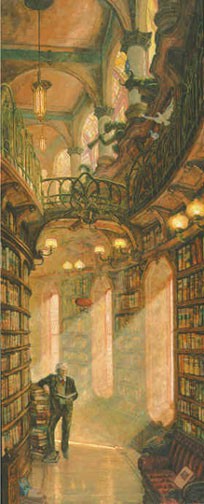
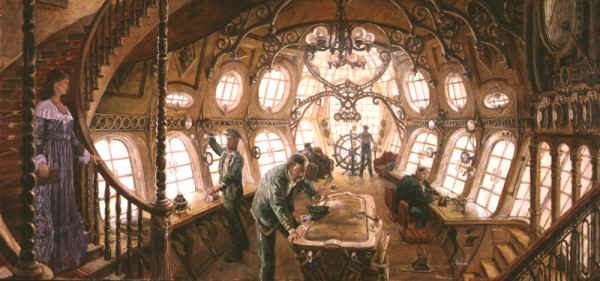
Found via a link by Angelus on the steamfashion community, these lovely paintings by Tom Kidd of Genomo -- a "a state of mind, a craving for adventure, the need to travel into unknown territory just to see what is there, the desire to have new experiences and to work with great people – maybe, even, dare to be great yourself. "

There are lots of paintings on the website, but these are two of the most appealing interiors. To the left is Peale's library:
With the early morning light sparkling against his marble floor, deep in his musty library, with gargoyles perched above and shelves of books packed tightly below Charles Wilson Peale III searches through documents....


There's also the navigation gondola of HMAS Wyeth. It reminds me of Paris, in an Eiffel Tower/Metro Station iron work sort of way.


Related: Airship Fantasy Room

LinkWithin

Related Posts Widget for Blogs by LinkWithin